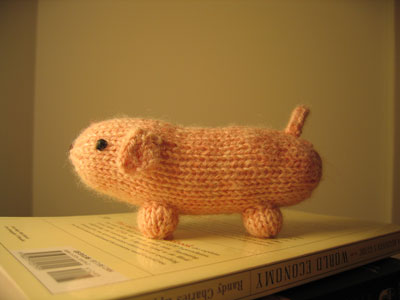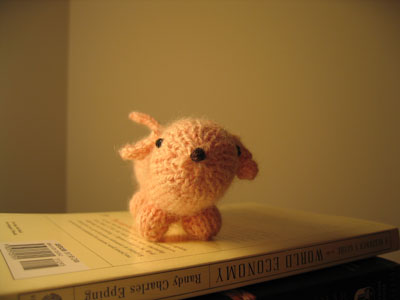
A gourmet treat even this vegetarian can get excited about.
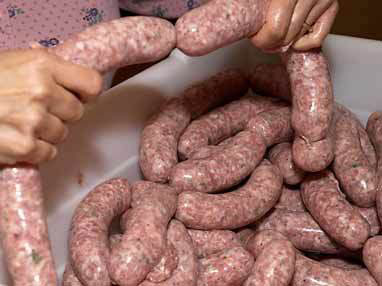
Inspiration
Sniff-a-long

A gourmet treat even this vegetarian can get excited about.
Inspiration
Sniff-a-long
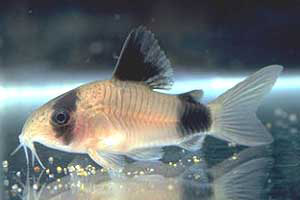
This is a panda cory (Corydoras panda). These bottom dwelling mini-catfish are just about as cuddly as fish can get. The blog that I swiped the above image from describes them as “cute, comical, hardy, and friendly,” none of which were words I thought could describe fish until my husband (then boyfriend) brought some pandas home.
As a still photo, this panda has about 50% of the cuteness of live pandas swimming around. Since they’re bottom dwellers, they spend all day nudging their little whiskers around in the dirt at the bottom of the tank, and their characteristic “buddy system” means that they’re always playing follow the leader.
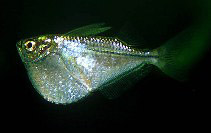
Also darling are hatchet fish (Gasteropelecus sternicla). To me, they look like little cartoon mayors swimming around the top of the tank. Their favorite activities include calling meetings and issuing resolutions. (They also like to jump, so keep that lid closed!)
Always do your research before buying a fish. They are animals that deserve good care and a proper environment!
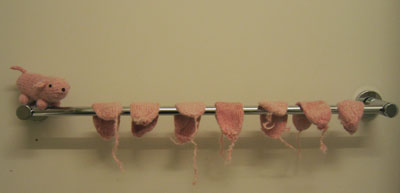
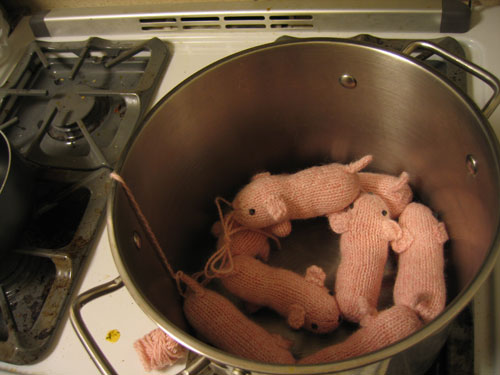
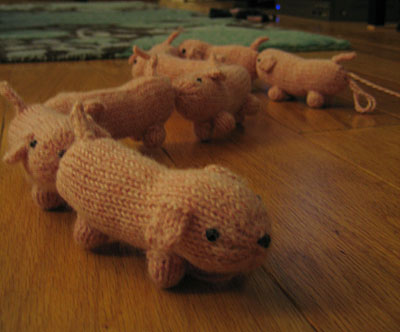
The Sausage Dog factory is in full swing! Above, Dog #1 looks on as dogs-to-be dry out from a botched felting job. (That 100% Alpaca really stinks just out of the dryer!)
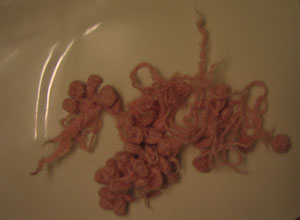
Seven sets of feet, ears, and tails all in a jumble.
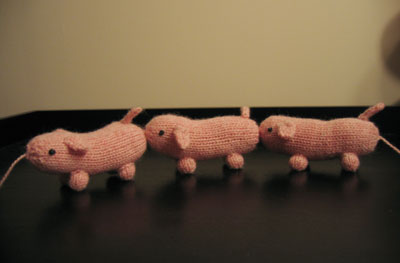
Three strung-up dogs. Looking pretty good! Full results coming soon. (Still thinking about the best way to photograph them – wouldn’t they be cute hanging in a real butcher’s?)
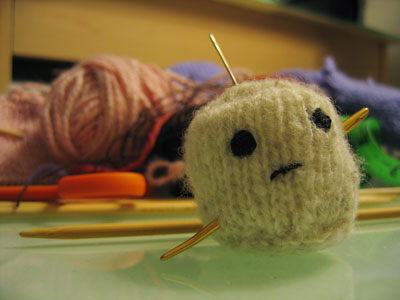
My latest attempt at organization involved sacrificing an innocent little marshmallow for a makeshift pincushion. I too wish it hadn’t come to this, little buddy.
June 2020 Update: I’ve revised this pattern to include circular knitting instructions! The new version is now available as a free download on Ravelry. The original version is below.
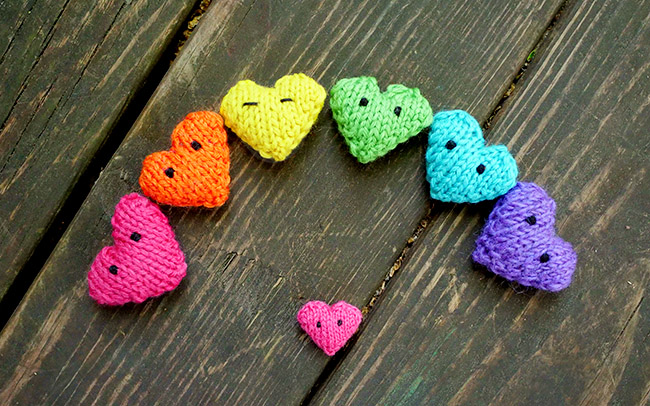
This is a free and easy pattern for you to make and share. Please check out the Mochimochi Land shop for more patterns that you’ll love!
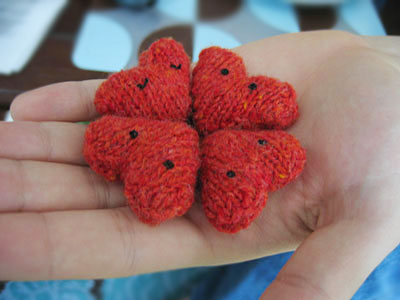
For anyone looking for a last-minute hand-made Valentine’s Day gift idea, done and done! These little hearts make a perfect topper for a box of chocolates, or a little handful of them will make your sweetie smile.
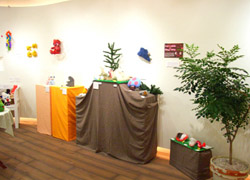
The “Luv-able and Hug-able” plush show is still up at Gallery LELE in Tokyo (you can faintly see three of my works hanging on the wall in the above itty-bitty photo), but for those who can’t make it there by February 11th, a couple of my toys from the show are now available for purchase at the gallery’s online shop. (They’re being exhibited under my name, Anna Hrachovec.)
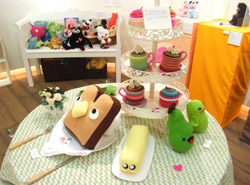
It’s pretty exciting to see my toys alongside the classic plushes by My Paper Crane and the exquisite work of Betz White, among other amazing artists.
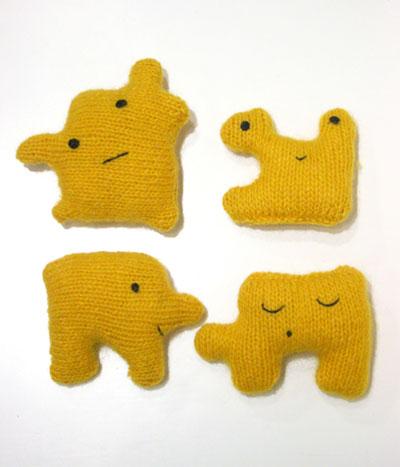
Here is a close-up of my piece “Wuzzle” in the show. The four creatures fit together puzzle-style, or they can also go solo as in the photo. The top left one looks a little warped here – they’re a bit of an unruly bunch, but you can’t say that they haven’t got character.
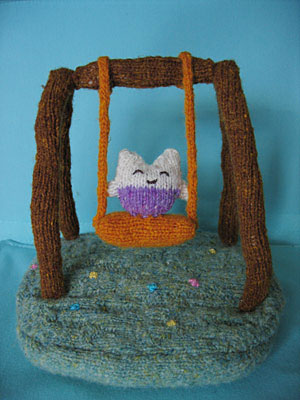
This is a thing that swings. It’s my first motion-oriented toy – somehow, it’s pretty interesting just to give the creature a little push and watch the swing go back and forth a few times. I guess because you don’t expect to see this kind of kinetic motion from a stuffed toy.
I really like the idea of soft toys that move or suggest movement. Aside from this kind of structural work, I’m thinking about eggs that are in the process of hatching, so that you see a foot or a wing sticking out of the crack in a worried-looking anthropomorphic egg. (To me, this egg is a particularly interesting existential question – once the live, fluffy chick hatches out of the egg, what happens to the shell with all that personality? Does the poor thing have to die?)
In any case, Swinging Thing gets its structure from wire, which kind of feels like cheating, but it’s not a toy that’s meant to be hugged and squeezed anyway. It was really fun (albeit nerve-wracking) to construct, and I’m hoping to make a few more of these kinds of sculptural knits. Perhaps a monkey swinging from a tree?